
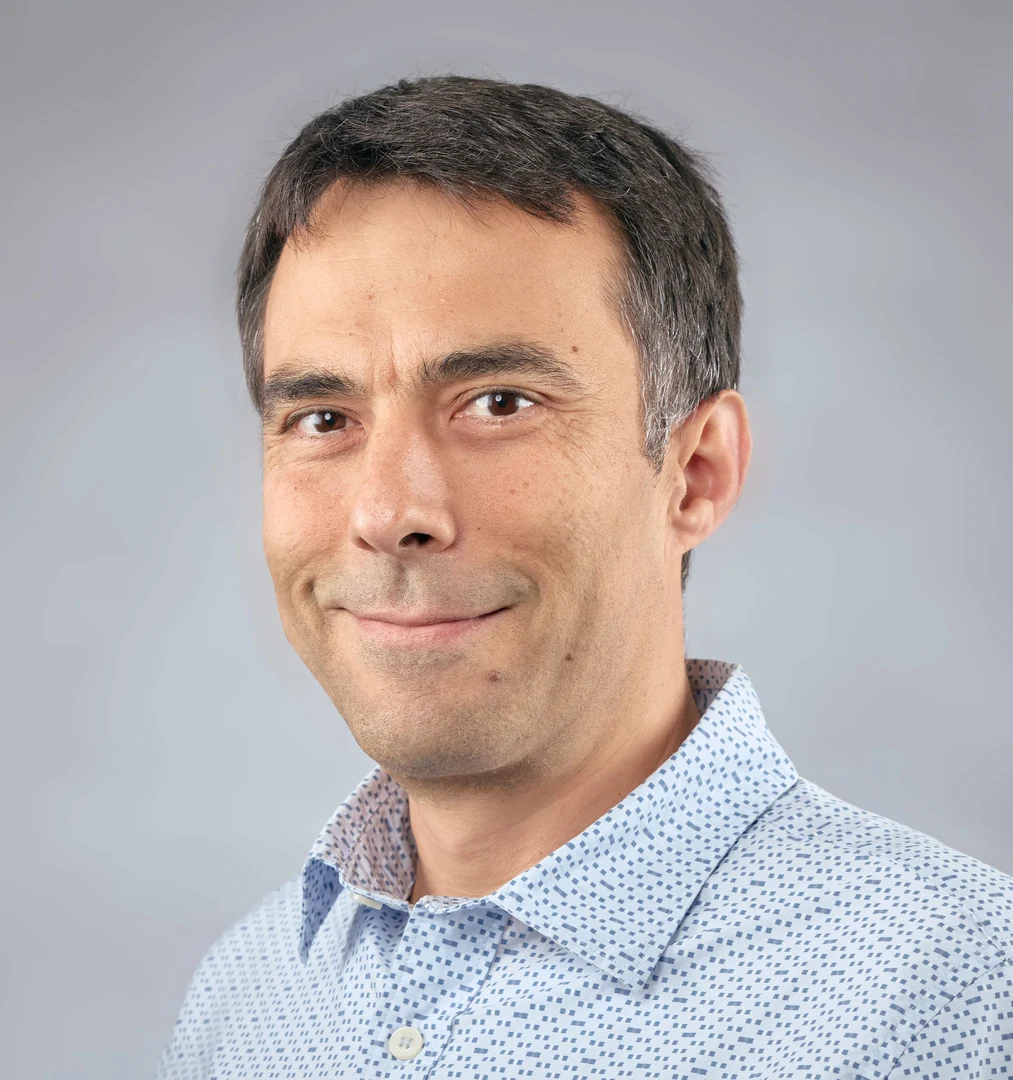
Tasho Kaletha is awarded a 2026 Chevalley Prize for two papers: "Regular supercuspidal representations" (2019), Journal of the American Mathematical Society, and, "A twisted Yu construction, Harish-Chandra characters and endoscopy" (2023), joint with Jessica Fintzen and Loren Spice, Duke Mathematical Journal,; and for the book Bruhat-Tits Theory, a New Approach, joint with Gopal Prasad. The papers make striking advances towards an explicit local Langlands correspondence for a large class of supercuspidal representations, settling delicate issues around the problem, and developing character formulas compatible with requirements suggested by the trace formula (specifically, the theory of endoscopy). The book modernizes Bruhat-Tits theory, providing clear resolutions of subtleties that had been raised by the extensive use of the theory for constructing supercuspidal representations, making it accessible for current and prospective researchers.
Tasho Kaletha received his undergraduate degree from the University of Bonn in 2005, where he studied with Günter Harder, and his doctorate from the University of Chicago in 2010, advised by Robert Kottwitz. He was a Veblen Research Instructor and later Assistant Professor at Princeton and a Benjamin Peirce Fellow at Harvard before joining the faculty at the University of Michigan. In 2024, he moved to the University of Bonn and became member of the Hausdorff Center for Mathematics.
The Chevalley Prize in Lie Theory is given for notable work in Lie theory published during the preceding six years. The prize was established in 2014 by George Lusztig to honor Claude Chevalley (1909-1984). Chevalley was a founding member of the Bourbaki group who made fundamental contributions to class field theory, algebraic geometry, and group theory. This prize is given biennially to early- or mid-career mathematicians.