
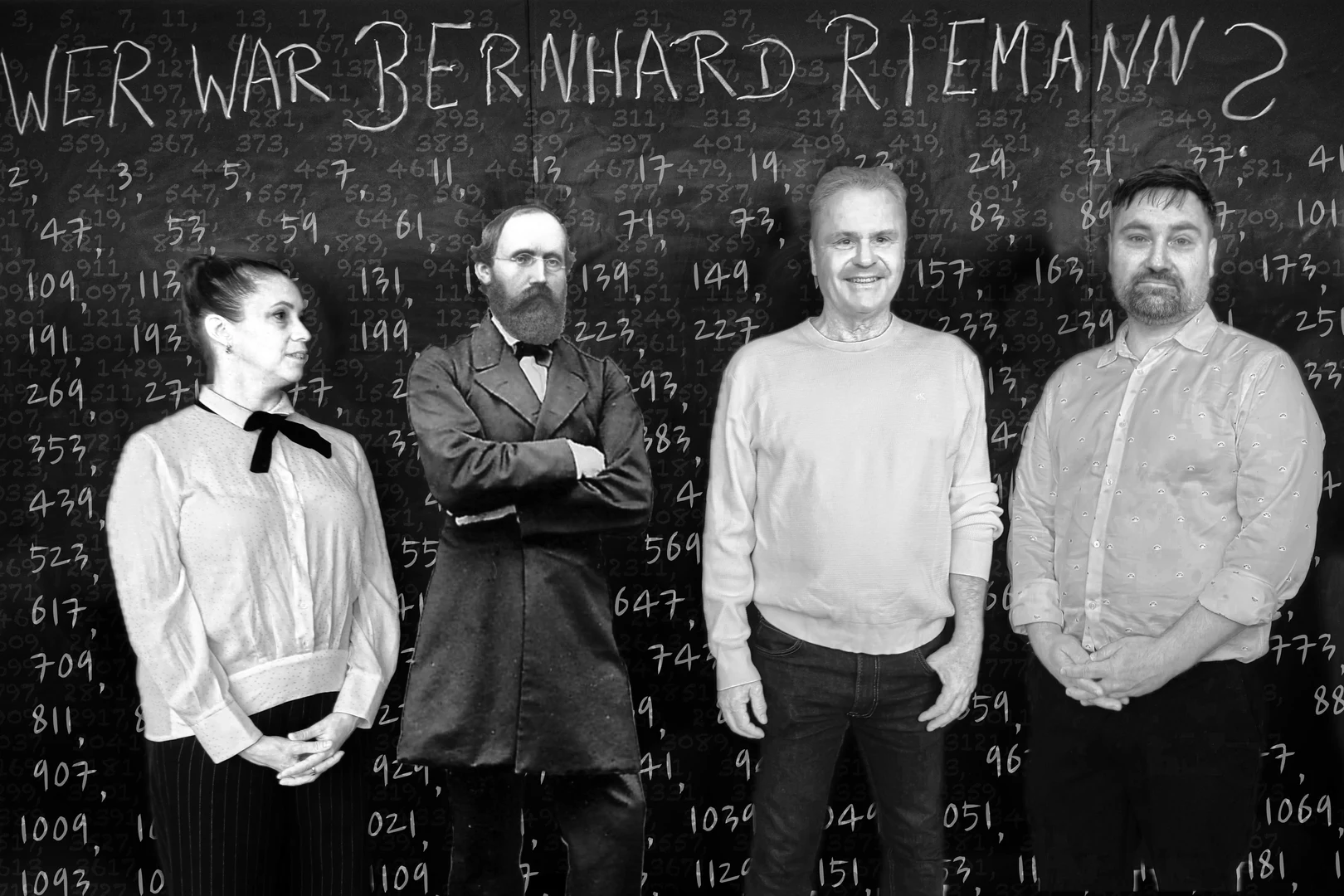
Bernhard Riemann (1826–1866) had a lasting impact on mathematics. His life was short, yet he made fundamental contributions in many areas of mathematics that are still considered groundbreaking today: For example, he was the first to introduce curved spaces and, with the Riemann Hypothesis—named after him—he shed light on one of mathematics’ great mysteries: the distribution of prime numbers. In 2000, the Riemann Hypothesis was included by the Clay Mathematics Institute on the list of the seven Millennium Problems in mathematics, for the solution of each of which a prize of one million U.S. dollars was offered. But who was the man behind the famous mathematician? And how did his scientific works come to be preserved for posterity?
The play “Who Was Bernhard Riemann?” explores these questions from the perspective of three people who were particularly close to Riemann or who recognized his work early on: Elise Riemann, who played a key role in ensuring the publication of her husband’s works after his death; the mathematician Richard Dedekind, who recognized Riemann’s mathematical genius early on; and Wilhelm Weber, a physicist, teacher, and fatherly friend of Riemann’s. From their respective perspectives and through their collective narrative, a vivid portrait of Bernhard Riemann emerges — of his life, his mathematics, and the people who shaped him.
The director is Sandra Schüddekopf, who has lived in Vienna for many years and, working with Sand-Production, focuses on cross-border productions in collaboration with scholars, as well as work in the field of children’s and youth theater. She remembers exactly what sparked the idea for the play: “How do you portray a person when you don’t know everything about them?” At the beginning, we had very different ideas about what that might look like. I quickly came up with the idea that there would have to be three characters who talk about Riemann from very different perspectives and shed light on very different aspects of Riemann’s life and work. And then an intensive exchange with David Rowe began, one that continues to this day.”
The play was created as a co-production between Sand-Production Vienna and the Hausdorff Center for Mathematics, a Cluster of Excellence at the University of Bonn, in cooperation with Dorothea Bahns of the Institute of Mathematics at the University of Göttingen. The production is supported by MATH+: The Berlin Mathematics Research Center Cluster of Excellence, the Max Planck Institute for Mathematics in the Sciences in Leipzig, and the Mathematics Münster Cluster of Excellence. The premiere is made possible by a generous grant from Walter Purkert and is being organized in collaboration with the Bonner Matheclub e.V.
The world premiere will take place on Thursday, November 12, 2026, in the event hall of the LVR Landesmuesum in Bonn, Colmantstraße 14–16, 53115 Bonn. The program begins at 6:00 p.m.; doors open at 5:00 p.m. Prior registration is required. Before the performance, the historian of mathematics David Rowe — who played a key role in developing the content — will give a brief introduction. Valentin Blomer, a professor of mathematics at the University of Bonn and a concert pianist, will entertain the audience with a musical interlude at the piano.
Additional performances are scheduled for November 14, 2026, in Göttingen, and November 18 and 19, 2026, in Münster. Performances in Berlin and Leipzig are in the works.