
Date: April 27, 2026 - July 6, 2026
Place: Mathematikzentrum, Lipschitz-Saal, Endenicher Allee 60, 53115 Bonn
Organizer: Michael Friedman, Henning Heller, Hannes Junker, Rainer Kaenders und Walter Purkert
- Paulo Freire (Max-Planck-Institut für Radioastronomie Bonn), Visualizing the higher dimensions: the regular polytopes in four dimensions and higher
- François Lê (Université Claude Bernard Lyon 1), On the Past of Mathematical Objects
- Katja Krüger (TU Darmstadt), Zur Einführung des Stochastikunterrichts in der BRD seit den1960er Jahren
Monday, April 27, 2026
16:00 - 16:30: Tea and Coffee
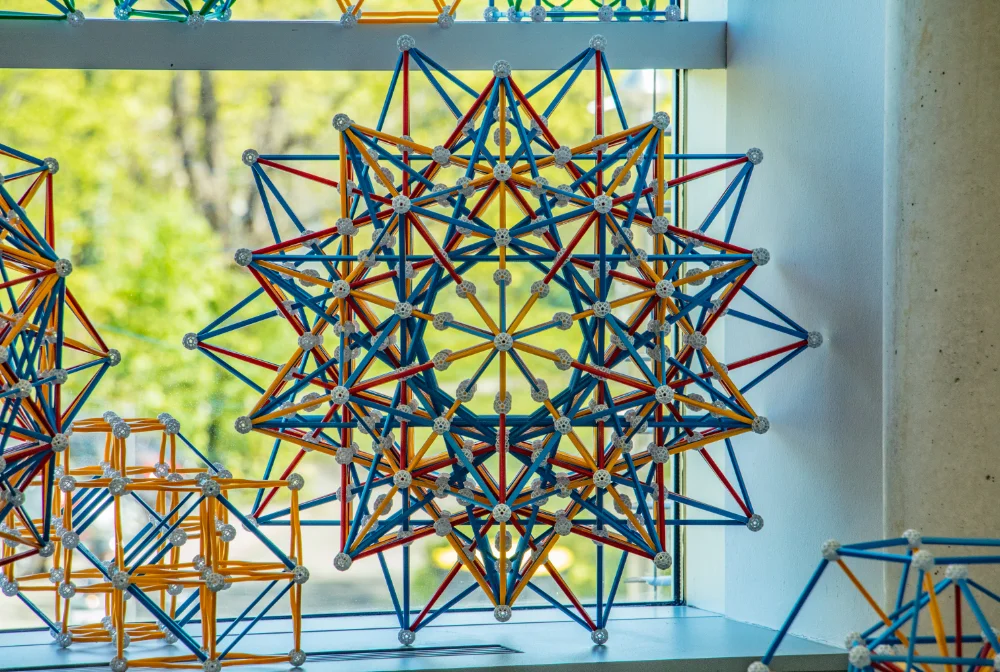
16:30 - 18:00: Paulo Freire (Max-Planck-Institut für Radioastronomie Bonn), Visualizing the higher dimensions: the regular polytopes in four dimensions and higher
Monday, June 15, 2026
16:00 - 16:30: Tea and Coffee
16:30 - 18:00: François Lê (Université Claude Bernard Lyon 1), On the Past of Mathematical Objects
Monday, July 6, 2026
16:00 - 16:30: Tea and Coffee
16:30 - 18:00: Katja Krüger (TU Darmstadt), Zur Einführung des Stochastikunterrichts in der BRD seit den1960er Jahren
Paulo Freire (Max-Planck-Institut für Radioastronomie Bonn), Visualizing the higher dimensions: the regular polytopes in four dimensions and higher
In this talk, I will present some projections of higher-dimensional polytopes to our 3-D space. This includes especially the four-dimensional regular polytopes, but I will also present some additional six-dimensional and one eight-dimensional polytope. I start the talk by making a brief presentation of the Zometool system. This will be followed by a discussion of some of the different types of projections, with an emphasis on orthographic projections, highlighting the fact that they are affine transformations, and what this implies for the projections. I then continue discussing the properties of the Platonic solids and their projections to two dimensions, especially their symmetries and how the symmetry of the polyhedron is related to the symmetry of the projection. I will also discuss how the symmetries affect directly the geometric properties of polyhedra and their projection. I then introduce the four-dimension analogues of the Platonic solids, the regular polychora, with a discussion of some of their projections to three-dimensional space represented by Zometool models, with a detailed discussion of their symmetries and the symmetries of their projections. At this stage, the audience will be able to participate in the construction of a model of one of the regular polychora, the Icosahedral projection of the 600-cell. Finally, I will mention some interesting objects in higher dimensions, and some general principles for constructing their projections.
François Lê (Université Claude Bernard Lyon 1), On the Past of Mathematical Objects
The question of understanding the past of a mathematical object is among the most common for those interested in the history of mathematics. However, it is often delicate to answer: even after reasonably identifying a date when the chosen object was first defined, one must trace back through time to locate earlier versions of this object and then understand the historical continuities that link these versions together. My presentation aims to illustrate these questions through the example of the genus of algebraic curves, a first definition of which can be attributed to the German mathematician Alfred Clebsch (1833–1872). I will particularly describe two distinct genealogical paths that led to this definition: one connected to the theory of abelian functions, through the work of Abel, Jacobi, Riemann, and others; the other related to the classification of algebraic curves, as explored by Descartes, Newton, Euler, and Cramer.
Katja Krüger (TU Darmstadt), Zur Einführung des Stochastikunterrichts in der BRD seit den 1960er Jahren
Ausgehend von der Reformbewegung der Neuen Mathematik in den 1960er Jahren werden zeitgenössische Vorschläge zur Begründung und inhaltlichen Gestaltung des neu eingeführten Stochastikunterrichts an Gymnasien in der BRD dargelegt. Ein besonderes Augenmerk liegt dabei auf der Sekundarstufe I, weil hier das erforderliche Grundwissen für den Unterricht in der Wahrscheinlichkeitsrechnung und Statistik in der Oberstufe altersangemessen aufzubauen ist. Insbesondere die Arbeiten von Arthur Engel und Hans Schupp haben mit ihrer praxisnahen Pionierarbeit den Weg für einen problem- und anwendungsorientierten Stochastikunterricht in der Schule bereitet. Schließlich wird herausgearbeitet, wie sich die mathematikdidaktische Teildisziplin der Stochastikdidaktik bis in die 1980er Jahre entwickelte.